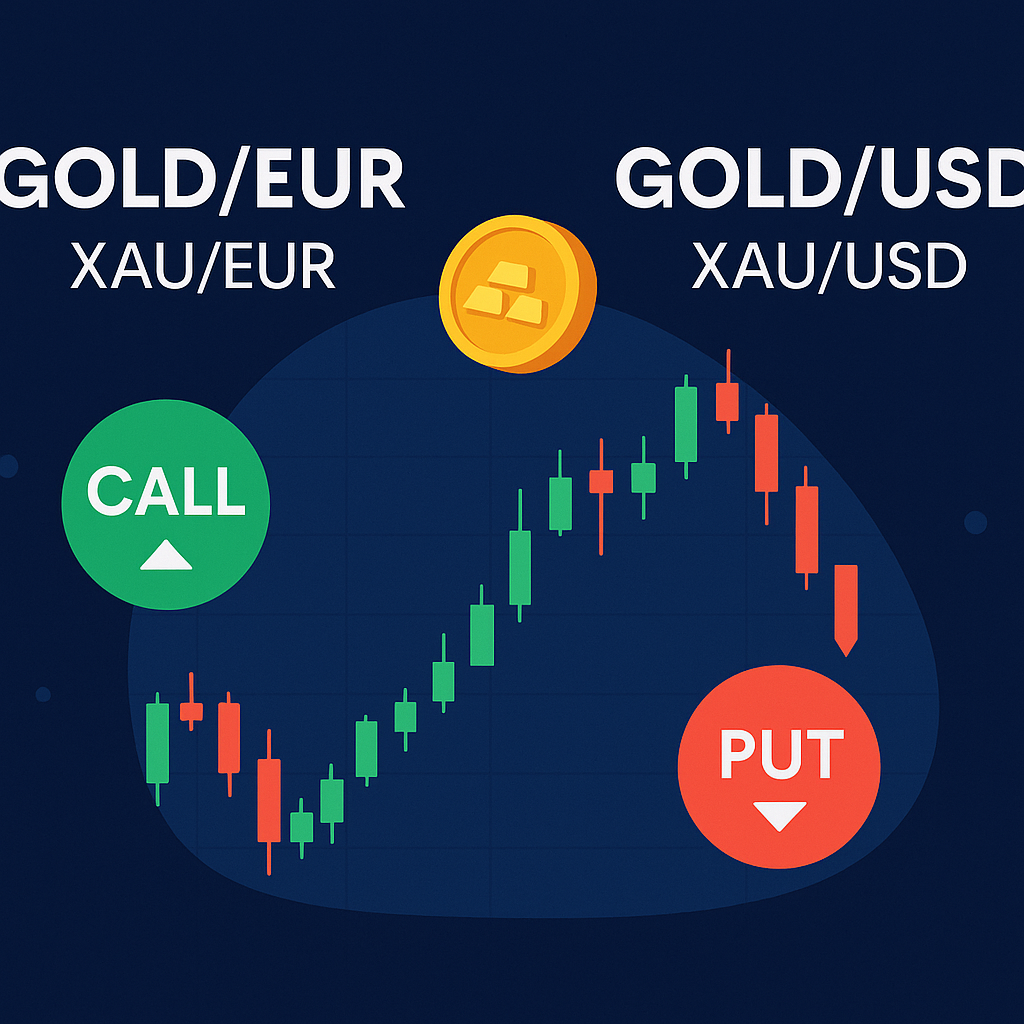
Gold’s Crossroads: The Case for Both Puts and Calls in XAU/EUR and XAU/USD
Over the past few weeks, gold has been trading in a tightening range — torn between geopolitical uncertainty, shifting central bank expectations, and an exhausted risk premium. Volatility has compressed again after October’s violent selloff, and both XAU/EUR and XAU/USD are now hovering around critical technical levels.
That’s the kind of setup I like — where both directions are plausible, but the timing and pricing of asymmetry become the real trade.
Technicals: Coiled, Not Calm
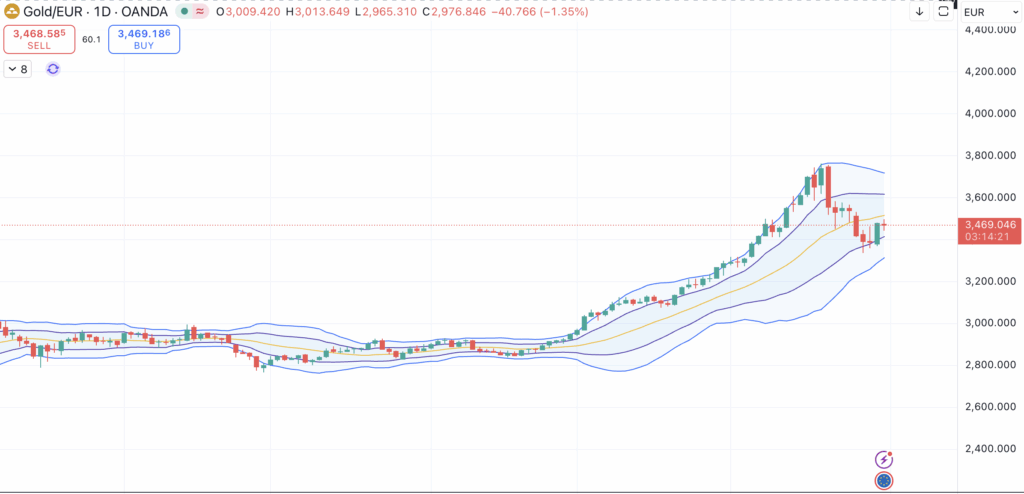
Gold’s daily chart tells a story of tension, not tranquility.
Both XAU/USD and XAU/EUR have been bouncing between short-term supports and failed breakouts:
- Multiple bearish continuation patterns — flags, descending channels, and failed supports — dominate the 15-minute to 1-hour timeframes.
- On the higher 4-hour charts, a few emerging bullish wedges are forming, but they remain unconfirmed.
- Volatility has bled lower, sitting near 20–21% implied vol for near-dated puts — well below the October spike.
That’s a recipe for a market that looks flat on the surface but is ready to move hard when the next catalyst hits.
The Put Case: Cheap Convexity Ahead of a Risk Shift
With volatility low and prices consolidating near mid-range, puts have quietly become attractive again.
For XAU/EUR, short-dated November structures are trading at modest deltas and thin premiums — especially the 3,400–3,420 strikes expiring in about 3–4 weeks.
Here’s the logic:
- If geopolitical risk eases — say, positive trade developments between the U.S. and China or renewed talks involving Russia — gold could slip below 3,350, potentially even test 3,250.
- That scenario would likely come with a volatility repricing, amplifying gains for existing put holders.
- Risk is capped, reward is convex — the kind of asymmetry that fits my approach perfectly.
I like to hold these kinds of positions over weekends, when gaps and headlines do the heavy lifting.
Markets don’t move linearly; they jump. Owning optionality during those “offline hours” is where the real edge lies.
The Call Case: Tactical Opportunity if Momentum Reverses
That said, gold’s downside isn’t guaranteed.
If the Federal Reserve or the ECB turn unexpectedly dovish in the coming days, or if inflation data undershoots, the dollar could weaken — and gold might pop higher, fast.
In that case:
- A short-dated call spread (for example, long 3,520 / short 3,600 XAU/EUR) offers cheap exposure to a breakout without overpaying for time value.
- The same logic applies to XAU/USD, where calls around 2,380–2,400 offer an appealing convexity-to-cost ratio.
But this remains a reaction trade, not a base case.
Until we see daily closes above 3,520 (EUR) or 2,370 (USD), the chart still favors fading rallies, not chasing them.
Volatility as the Trade
At this stage, it’s not about being bullish or bearish on gold — it’s about being long volatility in disguise.
When price compresses and the narrative feels indecisive, the smart trade isn’t prediction — it’s preparation.
The key takeaway:
- If gold breaks lower, short-dated puts pay quickly.
- If it spikes on macro relief, cheap calls absorb the reversal.
- If nothing happens, small theta decay is the only cost of staying optional.
That’s a fair price for being positioned when the next move hits.
Bottom Line
Gold is sitting at a crossroads between technical compression and geopolitical noise.
Whether you trade XAU/EUR or XAU/USD, option structures now provide a rare chance to own volatility cheaply — right before a week packed with macro catalysts, including central bank commentary and potential political breakthroughs.
In short:
The market is quiet — but not stable.
And quiet markets are where the best option trades are born.
FAQ: Trading Gold Options (XAU/EUR & XAU/USD)
Gold’s volatility has compressed again after a strong October move, making both puts and calls relatively cheap. With macro catalysts ahead and mixed technicals, owning convexity in either direction allows traders to benefit from volatility expansion — not just price direction.
In XAU/EUR, key resistance sits around 3,520–3,550, while support is clustered between 3,350–3,400. For XAU/USD, the 2,370 zone marks short-term resistance, with downside potential toward 2,280 if momentum breaks lower.
Weekend risk brings potential for news-driven gaps when markets reopen. Holding options during those periods provides exposure to large moves — especially when geopolitical or central bank headlines hit while trading is closed.
When implied volatility drops near 20–21%, option premiums shrink, reducing the cost of exposure. Traders can accumulate positions with limited downside while maintaining high convexity if volatility suddenly spikes after macro events.
For tactical exposure, expiries around 19–26 days strike the right balance — enough time for upcoming events (like potential trade talks or central bank guidance) to trigger movement, without overpaying for theta decay.