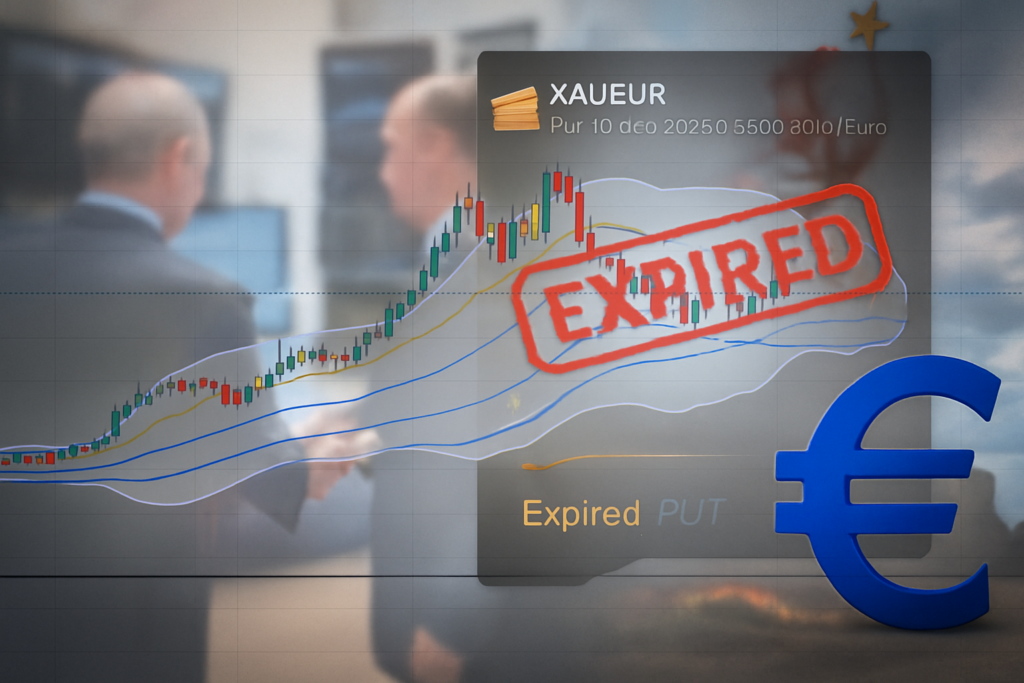
When a Thesis Doesn’t Trigger — Closing Out My XAU/EUR Put With a Full Loss
Not every trade pays, and not every catalyst arrives on schedule. My December 10 XAU/EUR put expired worthless — a full premium loss. And while that outcome is never pleasant, it is entirely in line with the type of trading I pursue: asymmetric optionality, catalyst-driven setups, and accepting small, predefined losses in exchange for the possibility of outlier gains.
This update closes the loop on that position and outlines what I take away from it.
1. The Thesis: A Clear Asymmetric Setup
In late November, several signals suggested that gold (priced in EUR) could be vulnerable:
- Reports of behind-the-scenes US–Russia peace discussions
- Trump’s renewed push for negotiations
- Market reactions in defense stocks (e.g., a sharp drop in Rheinmetall)
- A more hawkish tone emerging from parts of the Federal Reserve
- A fragile technical structure on XAU/EUR after weeks of sideways consolidation
These elements combined into a scenario where a sudden geopolitical shift — even if only partly credible — could have sent gold sharply lower.
A small, defined premium offered exposure to a potentially large downside break.
That asymmetry made the put attractive.
2. What Actually Happened: Gold Held Its Range
Despite multiple headlines hinting at possible diplomatic movement, none of it matured into actionable geopolitical pressure. Every “peace rumour” was followed by:
- Ukraine rejecting key elements of proposals
- European allies distancing themselves
- Russia signalling leverage rather than compromise
- The US adjusting tone but not delivering concrete agreements
In other words: the market received noise, not catalysts.
Gold never broke down. Instead, XAU/EUR drifted sideways-to-higher, supported by:
- A weaker euro at times
- Persistent global uncertainty
- Strong underlying demand for havens
- No confirmed shift in the direction of the war
By expiry, spot remained well above the 3,530 strike, and the put expired worthless.
3. Understanding the Loss: It Was the Cost of the Attempt
A full premium loss always stings — but the magnitude matters.
This was a controlled risk trade:
- Maximum loss was fixed from the start
- No margin exposure
- No tail risk
- No forced decisions
- No slippage beyond the premium
This is the design of options-based macro trading:
small repeated losses, occasional oversized wins.
The trade failed not because the thesis was poor, but because the catalyst simply did not materialize in time.
Timing is the difference between a home run and a zero.
4. Would I Take This Trade Again? Yes — with the same logic
Even in hindsight, the structure made sense:
- Volatility was cheap
- The macro environment was ripe for sudden moves
- Headlines were leaning toward possible breakthroughs
- Technicals were fragile
- Downside convexity was excellent
These conditions justify taking the shot.
The fact that the market didn’t break is a result, not a mistake.
As long as the maximum loss is controlled, outcomes like this are part of the game.
5. What Comes Next: Reset, Reassess, Reload
A losing option trade often provides better information than a winning one.
Here’s what I’m watching next:
(a) Peace signalling vs. market impact
The market is learning to discount political noise.
Only confirmed diplomatic movement will matter.
(b) FED and ECB divergence
A hawkish turn from the Fed could still hit gold — especially vs. EUR.
(c) XAU/EUR technical structure
Gold is stuck in a tightening range.
Compression precedes expansion, and the next macro catalyst could unleash it.
(d) Volatility conditions
If implied vol stays low, new options may again offer attractive asymmetry.
A new setup will eventually emerge — and I will write about it when it does.
Final Thoughts
This trade closed at a loss, but it remained exactly what I intended:
a low-cost attempt at capturing a high-impact event.
You cannot win big without accepting that many attempts will end like this one: quietly, cleanly, and with the loss already known upfront.
The edge comes from consistency, not perfection.
When the next asymmetric setup appears — whether bullish or bearish — I’ll be ready to take the next shot. And I’ll update here when I do.
FAQ
The geopolitical catalyst behind the trade never materialized. Gold held firm, volatility stayed muted, and XAU/EUR never approached the 3,530 strike before expiry, leading to a full premium loss.
The thesis wasn’t wrong — but the timing failed. Optionality bets rely on catalysts hitting within a defined time window. This one simply didn’t trigger before expiry, which is part of options-based macro trading.
The trade was sized as a controlled, predefined risk. The only reason to close early would have been narrative invalidation. But the story remained unclear, so holding into expiry was consistent with the strategy of targeting asymmetric outcomes.
Gold continued to resist downside despite multiple peace-related headlines. This shows the market currently discounts early diplomatic noise unless supported by concrete geopolitical progress.
Reset and reassess. The loss was capped and expected within this trading style. The next step is watching for new asymmetrical setups driven by peace signals, central bank shifts, or EUR dynamics.