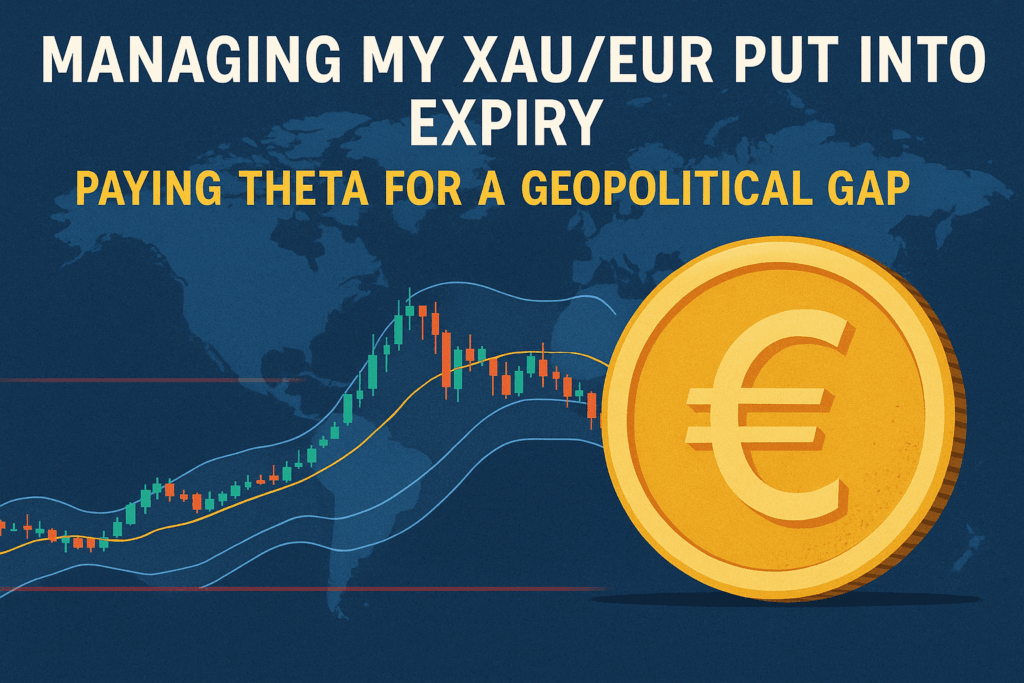
Managing My XAU/EUR Put Into Expiry: Paying Theta for a Geopolitical Gap
Gold hasn’t rewarded my patience yet — but that’s the point of this style of trading.
After the entry in my XAU/EUR put (strike 3,530, expiry Dec 10), the market moved against me. The option is now down sharply versus my entry price, with eight days left on the clock. That’s not a surprise. It’s the “cost of carrying” convexity when the world hasn’t delivered the headline.
But I’m still holding.
Not because I’m stubborn — because the setup I was buying hasn’t disappeared. It has simply not arrived.
I’m trading for asymmetry, not comfort.
What changed since the entry?
Since the trade went on, gold has stayed elevated and relatively sticky in EUR terms. The broader tone across risk has also been mixed: equity markets have held up, crypto has surged again, and “risk-on” isn’t dead.
Meanwhile, the peace narrative around Ukraine has turned into something more complicated than a clean, market-friendly headline. Bloomberg reporting highlighting the friction between Ukraine/European allies and parts of a US-Russian plan is exactly the kind of development that can keep gold supported in the short term — because “uncertainty” is still uncertainty. That’s the enemy of my put in the near term.
So yes: the position is currently bleeding.
But if you trade like I do, that’s normal. You pay small-ish (but real) carry most days, and you’re compensated in clusters when the catalyst actually hits.
Why I’m still holding (with 8 days left)
My thesis wasn’t “gold will drift lower politely.”
My thesis was: gold is priced for tension, but it’s vulnerable to a sudden re-rating if the narrative flips even slightly toward:
- credible progress on peace talks / de-escalation signals in Ukraine
- a more hawkish tone from the Fed (or an “inflation is not done” message)
- a broader shift into USD strength / tighter financial conditions
Any one of those can hit fast, often outside normal trading hours — and that’s exactly why I like owning options into weekends. Markets don’t move linearly. They gap.
And when they gap, options stop behaving like “a trade” and start behaving like a payoff function.
The real decision: manage the remaining time, not the P/L
With eight days left, my focus is no longer “do I like this trade?”
It’s: what is the best way to stay exposed to the asymmetric outcome without letting time decay turn a thesis into a slow leak?
Here’s the framework I’m using now:
1) If gold starts slipping and momentum finally breaks
If XAU/EUR rolls over and starts accelerating lower, I’ll likely stay with the position and look for a decisive move rather than micro-managing every tick. This is the scenario I bought the option for.
2) If we get a headline that sounds peaceful, but price doesn’t react
That’s a warning sign. Sometimes the market tells you the news is “not real” (or not sufficient) by refusing to reprice. In that case, I’ll consider reducing exposure — not because my thesis is wrong, but because time-to-expiry becomes the dominant enemy.
3) If nothing happens by the final stretch
If we drift sideways into the last few days, I’ll treat the remaining premium as a conscious insurance cost. That’s part of the game. I’d rather pay for optionality than be unhedged when the one headline finally hits.
The bigger picture: this is why I trade options
This trade is a clean reminder that contrarian option trading is not about being right quickly.
It’s about being positioned before the repricing.
Most of the time, you look early. Sometimes you look wrong. And occasionally — when the macro tape finally turns — you look inevitable.
Right now, I’m still in the waiting phase. The market hasn’t given me the move.
But the reason I’m still holding is simple:
The downside scenario I’m positioned for can still arrive in one headline — and the upside payoff is still meaningfully larger than what’s left to lose.
I’ll post the next update if we get a real catalyst — or if I decide to roll, cut, or rebuild the structure into the final week.
Because I didn’t buy this position for a slow drift — I bought it for a news-driven repricing. With limited time left, the trade becomes binary: either the catalyst hits and the convex payoff shows up, or the remaining premium is the cost of staying exposed to a potential gap move.
The biggest near-term triggers are anything that meaningfully shifts the risk narrative: credible Ukraine peace progress (or de-escalation signals), a more hawkish Fed tone that supports USD strength and tighter conditions, or a sudden drop in geopolitical tension that forces gold to reprice lower.
Time decay takes over. If spot stalls and volatility stays contained, the option can lose value quickly even if the thesis “still makes sense.” The main risk isn’t being wrong forever — it’s being right too late.
I focus on reaction, not opinion. If a headline hits and XAU/EUR fails to move, that’s a warning signal and I consider reducing exposure. If momentum breaks lower, I’m more likely to hold for the convex payoff. If nothing happens into the final stretch, I either accept the premium as insurance or roll into a new window where catalysts still matter.
Because markets gap on headlines when you can’t trade spot. Options are one of the cleanest ways to own that “offline risk” with capped downside. If the macro tape flips over a weekend, the open can deliver the asymmetry I’m paying for.